
For mountaineers around the globe, Mera Peak Climbing – 18 Days represents a bucket-list achievement — a chance to stand above the clouds with sweeping views of Everest, Lhotse, Cho Oyu, Makalu, and Kangchenjunga stretching across the horizon.
The journey sets off from Lukla, and the landscape transforms constantly as trekkers gain elevation. Some stretches of trail are rugged, rocky, and muddy in the rainy months, while others offer an easier, more relaxed walk. Along the way, the itinerary is designed to give the body enough time to adjust naturally to the thinning mountain air.
As climbers move higher, the terrain shifts noticeably — from uneven rocky paths to snow-covered slopes near the top. Trekking in groups is standard practice on this route, ensuring everyone’s safety through the more demanding sections.
Climbing Mera Peak doesn’t demand advanced mountaineering credentials, but it does call for care, discipline, and the right gear — including crampons and an ice axe for navigating the snowfields. These tools carry climbers toward the summit ridge, where one of the most rewarding panoramas in the Himalayas awaits.
Adventurers gravitate toward Mera Peak because it strikes a rare balance between elevation, accessibility, and overall experience.
A true high-altitude milestone. Rising to 6,476 meters, it holds the title of Nepal’s highest trekking peak — letting climbers experience serious altitude without venturing into extreme technical climbing.
Less technical than its neighbors. Compared to peaks like Island Peak or Lobuche Peak, Mera Peak’s ascent is far more approachable. Most of the route involves steady glacier walking and a gradual climb rather than vertical rock or ice faces.
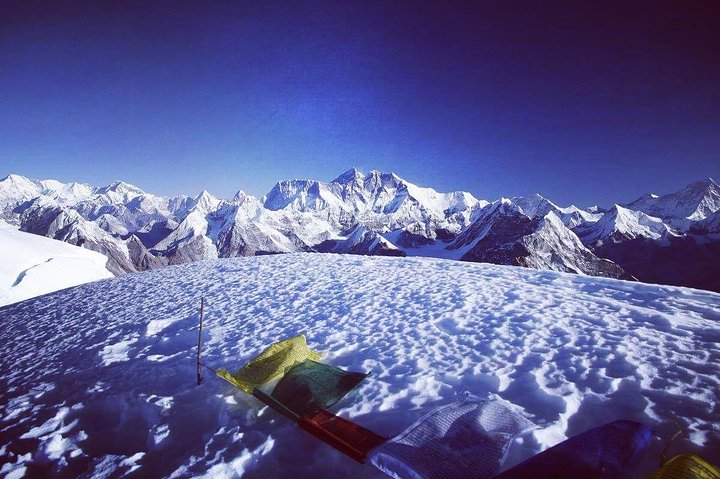
Unmatched summit views. From the top, climbers are rewarded with panoramic vistas of Everest, Lhotse, Makalu, Cho Oyu, and the wider Himalayan range — one of the broadest mountain views achievable from any trekking peak in Nepal.
A perfect first expedition. Mera Peak is widely regarded as an ideal introduction to high-altitude mountaineering, giving newcomers a structured, supported environment to learn about altitude management, climbing equipment, and expedition logistics.
Situated within the Mahalangur range of the Nepalese Himalayas, Mera Peak stands out as one of the more attainable high-altitude climbs precisely because it involves minimal technical climbing. It welcomes both first-time trekkers building mountaineering experience and seasoned climbers alike, though a working knowledge of basic mountaineering techniques is recommended.
That said, safety shouldn’t be taken lightly — the extreme altitude remains the defining challenge of this trek. Overnight stays in teahouses and tented camps at high elevation can be demanding, particularly for those new to Himalayan trekking.
For climbers venturing into Nepal for the first time, it’s worth building experience on other renowned routes first — such as the Annapurna Circuit, the Kanchenjunga Trek, or the Langtang Gosaikunda Trek — to acclimatize to mountain living and elevation before attempting Mera Peak.
With thoughtful preparation, a well-paced itinerary, and steady determination, reaching the summit of Mera Peak is well within reach for motivated trekkers.
Several route options exist for climbing Mera Peak, and the path you take depends on your chosen itinerary. Routes can also be tailored to match personal preferences, fitness levels, and available time. The main options include:
Note: Trekking with All Himalayan Treks allows you to choose the route best suited to your experience level and personal interests.
Mera Peak falls into the moderate technical category, though its physical demands — driven largely by altitude — should not be underestimated.
Unlike peaks such as Island Peak, the climb avoids steep rock faces or advanced alpine maneuvers. Still, climbers need a solid foundation in basic mountaineering skills, particularly for the final stretch to the summit.
Essential gear and skills include:
Ultimately, altitude and stamina present the greatest hurdles here — not technical terrain. Trekkers must be prepared to move steadily for extended hours in cold, oxygen-thin conditions.
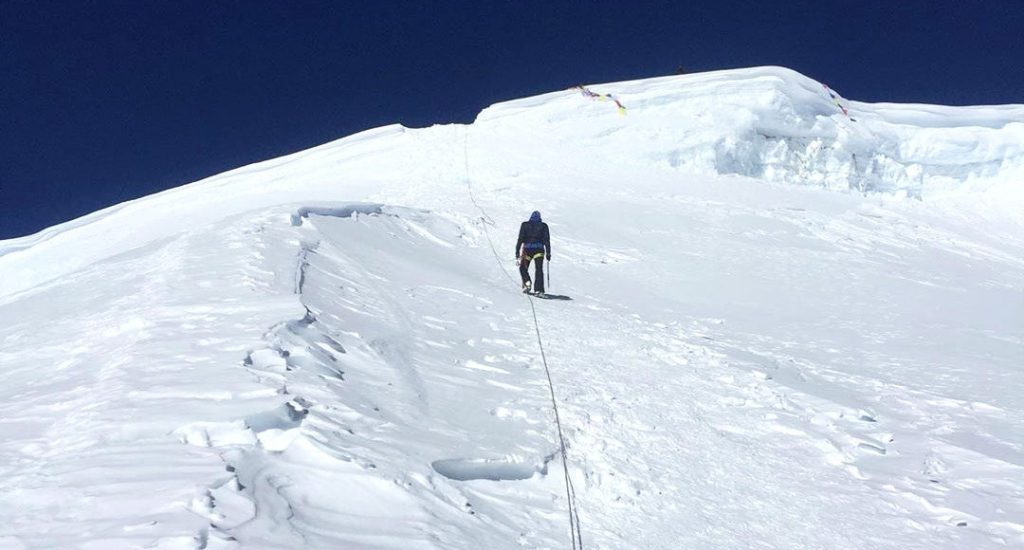
The upper portion of the route crosses glacial terrain, where climbers navigate snow-covered ground that may conceal crevasses. Rope teams are used throughout this section to maintain safety.
Near the final summit push, fixed ropes are typically installed, and climbers clip in using safety gear to manage the steeper incline.
Summit day generally takes between 8 and 12 hours round trip, with timing planned around early morning starts to take advantage of calmer weather and ensure a safe descent before conditions shift.
At elevations beyond 6,000 meters, oxygen levels drop to roughly 40–50% of what’s available at sea level. This thinner air slows movement, intensifies fatigue, and makes careful pacing essential for a safe summit attempt.
While not a technically demanding climb, Mera Peak still requires solid acclimatization, physical conditioning, and comfort handling mountaineering gear.
| Day | Route |
| 1 | Arrival in Kathmandu |
| 2 | Trip preparation and briefing day |
| 3 | Fly to Lukla, trek to Paiya (Chutok) |
| 4 | Trek from Paiya to Panggom |
| 5 | Trek from Panggom to Ningsow |
| 6 | Trek from Ningsow to Chhatra Khola |
| 7 | Trek from Chhatra Khola to Kothe |
| 8 | Trek from Kothe to Thaknak |
| 9 | Trek from Thaknak to Khare |
| 10 | Acclimatization day at Khare with pre-climb training |
| 11 | Trek from Khare to Mera High Camp |
| 12 | Summit push (6,461m) and descent back to Khare (5,045m) — approx. 8–9 hours |
| 13 | Reserve / contingency day |
| 14 | Trek from Khare to Kothe |
| 15 | Trek from Kothe to Thuli Kharka |
| 16 | Trek from Thuli Kharka to Lukla |
| 17 | Fly from Lukla back to Kathmandu |
| 18 | Final departure |
As a demanding high-altitude trek, Mera Peak requires solid physical and mental preparation before setting out.
While the route isn’t heavily technical, climbers should still build foundational mountaineering skills — including proper use of climbing gear, ice axe technique, glacier travel, route navigation, and high-altitude awareness.
Equally important is physical conditioning. Focus on building cardiovascular endurance, muscular strength, and stamina well before the trek to handle the physical strain of walking at altitude and the demands of summit day.
Climbing permits for Mera Peak cannot be arranged independently — trekkers must go through a registered Nepali trekking agency to obtain one. Permits are issued by the Nepal Mountaineering Association, and pricing varies by season:
| Season | Months | Permit Fee (USD) |
| Spring | March – May | $250 |
| Autumn | September – November | $125 |
| Winter | December – February | $70 |
| Summer | June – August | $70 |
In addition to the climbing permit, trekkers need a Khumbu Rural Municipality local permit (approximately $20) and a Sagarmatha National Park entry permit (approximately $30 per person).
Once you land and clear immigration at Tribhuvan International Airport (TIA), our team will be waiting outside to greet you and kick off your Himalayan journey.
From there, you'll be transferred to your hotel in Thamel, Kathmandu's lively tourist hub. After checking in, take the rest of the day to unwind and settle in before the adventure begins.
Following breakfast, head over to our office for a detailed trip briefing and a first meeting with your climbing guide, who will walk you through the route, logistics, and what to expect.
Thamel's busy streets are the perfect place to pick up any last-minute trekking gear, clothing, water purification tablets, or altitude medication such as Diamox. Equipment rental is also an option if you'd rather not buy.
Currency exchange counters are widely available nearby, so you can stock up on Nepali rupees for the trail ahead. Our staff is on hand throughout to help you shop or rent gear with ease.
Once preparations are complete, spend the rest of the day exploring Kathmandu's cultural landmarks — Durbar Square, Basantapur, Pashupatinath Temple, and Boudhanath Stupa are all worth a visit. Keep some local currency handy, as entry fees apply at several heritage sites. Overnight stay in Kathmandu.
Rise early for your flight to Lukla — one of the most thrilling short mountain flights in the world. In roughly 35 minutes, you'll touch down at Tenzing-Hillary Airport, gateway to the Khumbu region.
On a clear day, the Lukla airstrip offers jaw-dropping views of Everest (8,848m), Lhotse (8,516m), Nuptse (7,861m), Ama Dablam (6,812m), and other towering Himalayan giants.
From here, your trek begins with your guide and porter leading the way toward Paiya. The trail follows the Dudh Koshi River, crosses a suspension bridge, and climbs gradually to Chutok La Pass before descending into the village of Paiya, your overnight stop.
Leaving Paiya behind, the trail crosses a small river bridge — watch your footing, as the ground can be slick in places. From there, the path climbs steadily up to Kari La Pass, rewarding trekkers with sweeping mountain views along the way.
A steady descent follows, bringing you into Panggom, a charming farming and trading village nestled in the hills. Spend the night at a local guesthouse, resting up after a rewarding day on the trail.
After breakfast, set off from Panggom toward the Panggom La mountain pass, navigating a mix of uphill and downhill terrain along the way.
The trail leads to Pesang Kharka Khola, where crossing the river reveals striking views of rushing water framed by dramatic landscape. From there, continue along the Peeng Kharka Danda ridge before descending along the banks of the Ningsow River to reach Ningsow village, your stop for the night.
Today's trek involves a mix of climbs and descents en route to Ramailo Danda, where clear skies reveal stunning views of Mera Peak and Salpa Bhanjyang.
Continuing through varied terrain, the trail enters Makalu Barun National Park — a protected wilderness area known for its rich biodiversity. Following the Pasang Lhamu trail toward Chhatra Khola, keen-eyed trekkers may even spot the elusive red panda. Overnight stay in Chhatra Khola.
After breakfast, the route heads north along the main Mera Peak trail, tracing the Majang Khola River before joining the path along the Hinku Khola River.
The trail passes through Tashing Ongma, home to a handful of seasonal tea houses, before crossing a bridge over the Sanu Khola River and arriving in Kothe, where you'll spend the night.
With Mera Peak rising dramatically ahead, the trail follows the Hinku River past Gordishung, a small herders' settlement along the Hinku Drangna river.
The path continues to Lungsungba Gompa, a 200-year-old monastery featuring a rock inscription referencing Mera Peak. From there, a short walk brings you to Thaknak, a seasonal grazing pasture with basic lodges for an overnight stay.
Leaving Thaknak after breakfast, the trail skirts the edge of Dig Glacier en route to Dig Kharka, offering spectacular views of Charpate Himal.
Crossing rocky moraine terrain near the edge of the Hinku Nup and Hinku Shar glaciers, the path climbs toward Khare, where the towering north face of Mera Peak comes into full view. After lunch, take time to explore the surrounding area before settling in for the night.
A dedicated rest and acclimatization day, essential for adjusting to the thinning mountain air before pushing higher.
Stay well hydrated, pace yourself, and keep an eye out for early symptoms of altitude sickness. Your guide will also run a pre-climb training session, covering the proper use of climbing gear such as crampons, fixed ropes, carabiners, and ice axes, along with essential tips for the summit push ahead.
Today's trail crosses rugged, boulder-strewn terrain on a steep climb toward Mera Peak Base Camp, continuing on to Mera La Pass before reaching Mera High Camp.
Depending on recent snowfall, this stretch can involve navigating crevasses, so careful footing and guide supervision are key. The trail climbs a rocky path to a cairn marking the top of a rock band, where High Camp is established.
From this dramatic vantage point, enjoy sweeping views of Everest, Makalu, Cho Oyu, Lhotse's south face, Nuptse, Chamlang, and Baruntse. An early night's rest is essential ahead of the pre-dawn summit push.
Summit day has arrived. With an alpine start around 2 AM, climbers set off with headlamps and full gear for the final ascent of Mera Peak.
The route climbs across glacier terrain and up onto the summit ridge, with sunrise bringing warmth despite the biting cold. Guided by experienced Sherpa climbers and secured with fixed ropes, the final push to the top is both demanding and exhilarating.
From the summit, uninterrupted views of Everest and its neighboring giants stretch across the horizon — a powerful reward for the effort invested. After taking in the moment, the descent follows the same route back down to Khare, capping off one of the most memorable achievements of the trip.
Mountain weather at high altitude is notoriously unpredictable, so this buffer day is built into the itinerary in case poor conditions delay the summit attempt. If the summit push goes as planned, this day can simply be skipped.
After breakfast, begin the descent from Khare toward Kothe, passing through scenic terrain with a mix of short climbs and longer downhill stretches. After roughly four hours of trekking, arrive in Kothe for an overnight teahouse stay — a good chance to relax and swap stories with fellow trekkers.
The trail to Thuli Kharka alternates between uphill and downhill sections as it crosses the valley, passing streams and the picturesque village of Takho, dotted with traditional chortens along the way. Overnight stay in a guesthouse in Thuli Kharka.
The final trekking day follows a high ridge route over Naulekh (Kalo Himal), crossing the Zatrwa Og and Zatrwa La passes — a challenging but rewarding stretch.
After crossing the pass, the trail descends into Chutanga, welcomed by lush forest cover. From here, continue on to Lukla for an overnight stay, marking the end of the trekking portion of the journey.
With unforgettable memories of Mera Peak behind you, bid farewell to the Everest region with a scenic return flight to Kathmandu.
Upon arrival at TIA, our team will be there to welcome you back and transfer you to your hotel. Enjoy some free time to explore Thamel's streets for souvenirs, or unwind at a local restaurant, café, or bar.
Approximately three hours before your scheduled flight, you'll be transferred to the airport for your onward journey home.
Throughout the Mera Peak trek, overnight stays are arranged in local teahouses along the trail. Rooms are simple but comfortable — a welcome rest after a full day of trekking.
Basic amenities such as a bed, mattress, pillow, and warm blanket are provided. Facilities tend to be more comfortable at lower elevations and become progressively more basic as the trail climbs higher.
Three meals a day are served at the teahouses — simple, wholesome food designed to keep your energy up on the trail. Closer to the summit, trekkers stay in tents, with all necessary camping equipment arranged as part of the package.
High-altitude trekking comes with real risks — altitude sickness, sudden weather changes, rugged terrain, and physical fatigue from long trekking days. Because the likelihood of altitude-related illness increases significantly at elevation, and unexpected situations can arise on the trail, comprehensive travel insurance is essential.
Make sure your policy covers emergency medical evacuation (including helicopter rescue), medical treatment costs, trip cancellation, and 24/7 emergency support.
Most teahouses along the Mera Peak trekking route offer wifi, electricity for charging devices, and drinking water. These services usually come with a small additional fee, which is not included in the standard climbing package cost.
Trekkers can stay in touch using wifi along the route or by picking up a local SIM card (NTC or Ncell) for mobile data access. At higher elevations, where regular signal becomes unreliable, your climbing guide carries a satellite phone for emergencies, available for use at a minimal charge.
Having the right gear is essential for a safe and successful climb. Below is a recommended packing list for the Mera Peak expedition.
Note: Climbing gear rental is available in Kathmandu — reach out to us if you'd like help arranging rentals.
Mera Peak climbing is a high-altitude trekking peak expedition in Nepal. While it isn't a technically demanding climb, it does require basic mountaineering equipment — crampons, an ice axe, and fixed ropes — for the final stretch to the summit.
Standing at 6,476 meters (21,247 feet) above sea level, Mera Peak ranks among Nepal's highest trekking peaks.
Mera Peak sits in the Khumbu region of eastern Nepal, within Makalu Barun National Park, just southeast of Mount Everest.
Yes. It holds the title of Nepal's highest peak classified under the trekking peak category, making it a popular choice for climbers seeking high-altitude achievement without full expedition-level permits.
Most itineraries run between 14 and 18 days, depending on the chosen route, acclimatization schedule, and trekking pace.
Compared to more technical peaks, Mera Peak has a relatively high success rate — typically between 70% and 85% — influenced largely by weather conditions, acclimatization, and overall preparation.
The climb is considered moderate to challenging, with altitude posing a bigger obstacle than technical terrain.
Good physical fitness and proper acclimatization matter more than prior experience, especially with an experienced guide supporting the climb.
No prior technical mountaineering background is necessary — climbers receive basic training in using climbing gear before the summit push.
No. Despite its higher elevation, Mera Peak is generally regarded as less technically demanding than Island Peak.
Mera Peak is the easier climb technically. Lobuche Peak demands a higher level of climbing skill and experience.
Yes — crampons, fixed ropes, and standard mountaineering gear are essential for the summit section of the route.
Prices generally range from around $1,800 to $3,500, depending on group size, service level, and itinerary length.
Packages typically cover all required permits, guide and porter support, accommodation, meals, and climbing equipment.
Yes — due to the added cost of climbing permits, technical gear, and mountaineering logistics, Mera Peak climbing tends to cost more than the standard Everest Base Camp trek.
A tip of roughly 10–15% of the total trip cost, shared among the guide, porter, and support crew, is the customary standard.
A standard itinerary includes arrival in Kathmandu, a flight to Lukla, trekking through the Hinku Valley, scheduled acclimatization days, and a final summit push.
Climbing Mera Peak generally takes between 14 and 18 days from start to finish.
The Hinku Valley approach — the standard route to Mera Peak — winds through remote forested trails, alpine terrain, and stretches of glacier travel on the eastern side of the mountain.
Most Mera Peak itineraries begin in Lukla, though starting from Salleri is also a possible alternative route.
Yes — advanced itineraries sometimes pair Mera Peak with a crossing of the Amphu Lapcha Pass, though this addition requires prior technical climbing experience.
Yes, provided climbers follow a proper acclimatization schedule, trek with experienced guides, and attempt the summit during stable weather windows.
Mera Peak isn't inherently dangerous, but the risk of altitude sickness is significant given the climb passes above 6,000 meters.
Summit day begins early in the morning, crossing snow slopes and glacier terrain, with the full round trip typically taking 8 to 12 hours.
Climbers should have a high level of physical fitness and the ability to trek 5–7 hours a day at altitude over multiple consecutive days.
Recommended preparation includes aerobic conditioning, extended hiking sessions, and basic strength training in the months leading up to the climb.
Yes — first-time climbers can successfully summit Mera Peak with proper training, a well-paced acclimatization schedule, and experienced guide support.
A preparation window of at least 6–8 weeks is generally recommended.
Essential gear includes mountaineering boots, crampons, a climbing harness, an ice axe, a helmet, and proper insulated clothing.
Yes, both are required equipment for the summit portion of the Mera Peak climb.
Yes — most technical climbing equipment can be rented in Kathmandu, particularly around the Thamel area.
Double-layer mountaineering boots, built to withstand extreme cold, are strongly recommended for the summit push.
A full down suit isn't strictly necessary, but a high-quality down jacket is considered essential gear.
Alongside the Mera Peak climbing permit itself, trekkers also need a Makalu Barun National Park permit and applicable local area permits.
Yes — Mera Peak falls under Nepal Mountaineering Association (NMA) jurisdiction, so an NMA-issued climbing permit is mandatory.
No — given the technical nature of the summit section, hiring a licensed climbing guide is strongly required.
No — climbing permits require a minimum group size of two trekkers.
Spring (March–May) and autumn (September–November) offer the most favorable climbing conditions.
Yes, though winter climbers should be prepared for significantly harsher conditions, including extreme cold and unpredictable weather.
Conditions above 6,000 meters can turn harsh and unpredictable quickly, with temperatures regularly dropping below freezing.
April, May, October, and November tend to offer the clearest skies and most stable weather, giving climbers the best chance at a successful summit.
Yes — the summit offers a clear view of Mount Everest, the world's highest mountain.
From the top, climbers can take in views of Everest, Lhotse, Makalu, Cho Oyu, and Kanchenjunga.
Absolutely — it offers a genuine high-altitude mountaineering experience with sweeping Himalayan panoramas, all with comparatively manageable technical difficulty.
No — it remains far less crowded than routes like the Everest Base Camp trek, offering a quieter, more remote mountain experience.
With 10+ years of expertise in Nepal, Tibet, and Bhutan, Binaya is the right person to help you create a trip you’ll never forget.