
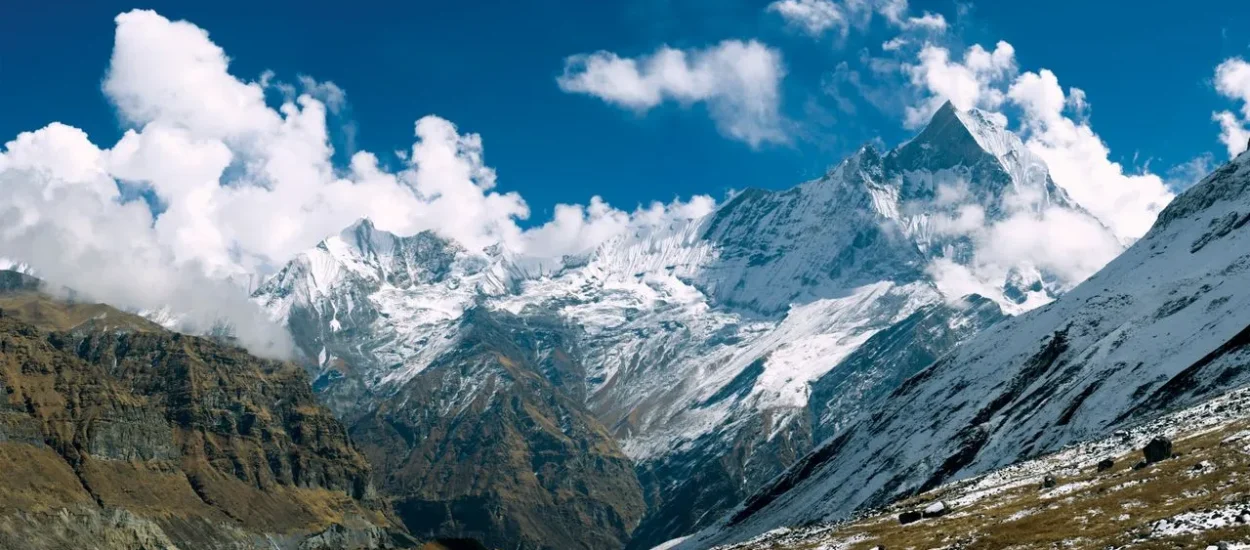
The Annapurna Base Camp (ABC) Trek ranks among Nepal’s most celebrated Himalayan adventures. It brings trekkers to an elevation of 4,130 meters (13,549 feet), sitting at the foot of Annapurna I — the 10th-highest peak on Earth at 8,091 meters.
Combining alpine scenery, high-altitude trails, and traditional mountain villages, this moderately challenging route delivers a world-class experience suited to both newcomers and seasoned trekkers alike. Many operators structure the route so hikers reach both Annapurna Base Camp and Machhapuchhre Base Camp on a single trip — which is why the journey is often called the Annapurna Sanctuary Trek.
The adventure begins in Pokhara, reachable via a short 30-minute flight or a scenic 6-hour overland drive from Kathmandu. Known as the gateway to the Annapurna Himalaya, Pokhara itself is worth savoring before the trek begins — home to Phewa Lake and unobstructed views of Annapurna I, II, and III, Hiunchuli, Gangapurna, and Machhapuchhre, along with access points to Ghorepani Poon Hill, Mardi Himal, the Annapurna Circuit, and Tilicho Lake.
From Pokhara, a private jeep transfers trekkers to Ghandruk, a picturesque Gurung settlement known for its warm hospitality, traditional cuisine, and unobstructed mountain backdrops featuring Annapurna, Machhapuchhre, Gangapurna, and Hiunchuli.
The trail itself winds through lush hillsides, rhododendron and bamboo forests, past waterfalls, cascades, and simple wooden footbridges. Along the way, trekkers overnight in local teahouses and lodges offering basic but comfortable rooms, meals, electricity, Wi-Fi access, and hot showers.
Beyond the mountain views, the real heart of the ABC Trek lies in its people — the local guides and porters sharing folklore and trail wisdom, the villagers offering a glimpse into their traditions, and the quiet satisfaction of resting in a teahouse surrounded by some of the tallest peaks on the planet.
Ready to experience it for yourself? Reach out to All Himalayan Treks through our website inquiry form, email us at info@econepaltrekkers.com, or contact us directly via WhatsApp, Viber, or IMO at +977-9813322433.
This is a moderate-difficulty trek with no technical climbing involved, making it accessible even to first-time trekkers — provided you’re reasonably fit and prepared for multi-day hiking.
Expect long stretches of stone steps, both ascending and descending, which can strain the knees if you’re not accustomed to sustained trekking. The trek’s highest point, Annapurna Base Camp at 4,130 meters, also means altitude effects are a real consideration, so proper acclimatization is essential to avoid altitude sickness.
Mountain weather is famously unpredictable — conditions can shift rapidly, bringing sudden temperature drops or short delays to your itinerary. Building a buffer day or two into your trekking plan is a smart way to stay flexible.
Across this 12-day journey, trekkers are treated to constant views of Annapurna I, Machhapuchhre (Fishtail Mountain), Hiunchuli, the Dhaulagiri range, and the broader Annapurna massif. These snow-draped summits tower above the clouds and leave a lasting impression long after the trek ends.
At the core of the trek lies the Annapurna Sanctuary — a natural amphitheater ringed by soaring peaks, most exceeding 7,000 meters, located roughly 40 kilometers north of Pokhara. This glacial basin holds deep spiritual significance for local communities and offers a serene, almost otherworldly atmosphere.
Few treks in Nepal offer this much scenic variety. The trail transitions from subtropical forest and rice terraces in the lower valleys to blooming rhododendron woods, pine and juniper forest, alpine meadows, and finally rugged, rocky high-altitude terrain — with icy rivers and glaciers rounding out the picture.
Set within the Annapurna Conservation Area, the region supports a wide range of flora and fauna, including rare and endangered species such as the snow leopard, Himalayan thar, red panda, and musk deer. Birdwatchers will also appreciate the many species calling this ecosystem home — pack a pair of binoculars if wildlife spotting interests you.
The trail passes through traditional settlements largely inhabited by the Gurung and Magar peoples. Their distinctive dress, customs, and genuine hospitality make trekkers feel instantly welcome — a big reason so many visitors return to Nepal again and again.
After the push to base camp, trekkers can relax in the natural hot springs at Jhinu Danda. Locals consider a soak here therapeutic for tired muscles and beneficial for skin health — a well-earned reward after days on the trail.
Watching the alpenglow paint the peaks in shifting shades of gold, pink, and orange at dawn and dusk is one of the trek’s most memorable experiences — a natural spectacle unlike anything found at lower elevations.
The route includes several steel cable suspension bridges spanning rushing rivers below — a thrilling contrast to ordinary trail walking and a highlight for adventure-seekers.
Sections of dense bamboo and rhododendron forest offer a peaceful, meditative contrast to the high alpine terrain. In spring, blooming rhododendrons paint the trail in vivid color, creating one of the most photogenic stretches of the journey.
The journey begins in Kathmandu, followed by a road transfer or short flight to Pokhara — the launch point for the ABC Trek. From there, a private jeep takes trekkers to Ghandruk to begin the hike.
Each day follows a similar rhythm: breakfast at the teahouse, a 5–6 hour trekking day with a scheduled lunch stop chosen by your guide, and an overnight stay at a pre-booked teahouse along the route. Trekkers move as a group alongside the All Himalayan Treks team throughout the itinerary.
Package pricing for the 12-day Annapurna Base Camp Trek typically ranges from $600 to $1,800, depending on your chosen itinerary, service level, transport preferences, accommodation standard, and meal plan.
All Himalayan Treks offers flexible service packages, including guide-and-permit-only options for independent trekkers.
| Group Size | Cost (USD) |
| Solo (1 person) | $1,050 |
| 2 people | $800 |
| 3–5 people | $750 |
| 6–8 people | $700 |
| 12+ people | $500 |
For a full cost breakdown, see our detailed guide: Annapurna Base Camp Trek Cost.
Note: Last-minute bookings are welcome.
Booking ahead for 2027 has clear advantages. Reserving early locks in current 2026 pricing, protecting you from future rate increases. It also guarantees your trekking logistics and departure date well in advance, helping you stay committed to the plan without second-guessing.
Early planning also gives you extra time to prepare physically and budget accordingly — making for a smoother, stress-free Himalayan adventure.
Day 1: Arrive in Kathmandu (1,350 m / 4,429 ft)
Day 2: Drive from Kathmandu to Pokhara (827 m / 2,713 ft) — 6–7 hrs
Day 3: Drive from Pokhara to Ghandruk, then trek to Chomrong (2,170 m / 7,119 ft) — 6 hrs
Day 4: Trek from Chomrong to Bamboo (2,310 m / 7,578 ft) — 5 hrs
Day 5: Trek from Bamboo to Deurali (3,230 m / 10,597 ft) — 5 hrs
Day 6: Trek from Deurali to Annapurna Base Camp (4,130 m / 13,549 ft) — 6 hrs
Day 7: Trek from Annapurna Base Camp back to Bamboo (2,310 m / 7,578 ft) — 8 hrs
Day 8: Trek from Bamboo to Jhinu Danda (1,760 m / 5,774 ft) — 6 hrs
Day 9: Trek from Jhinu Danda to Nayapul (2.5 hrs), then drive to Pokhara (827 m / 2,713 ft) — 2 hrs
Day 10: Drive back to Kathmandu (1,350 m / 4,429 ft) — 6–7 hrs
Day 11: Sightseeing in Kathmandu
Day 12: Final departure
The ABC Trek falls into the moderate difficulty category. Trekkers should be prepared for altitude gain, unpredictable mountain weather, physical exertion, and stretches of steep stone stairways. That said, difficulty is manageable with the right preparation — this isn’t an expedition reserved only for elite trekkers.
Altitude Reaching 4,130 meters (13,550 ft) over 12 days, this trek climbs high — though not as extreme as the Annapurna Circuit or Everest Base Camp treks. First-timers may still notice mild altitude effects such as headaches, nausea, or fatigue, while trekkers with prior high-altitude experience typically adjust with ease.
Terrain Trails alternate between well-maintained forest paths through villages and rockier, more rugged mountain sections. Some stretches can turn slippery after rainfall. Trekking outside monsoon season and sticking to the clearly marked trail keeps difficulty manageable.
Daily Trekking Hours Expect to hike roughly 5–6 hours per day. Seasoned trekkers will find this comfortable, but beginners should build up stamina beforehand, since consistent high-altitude walking demands solid leg strength and endurance.
Weather Conditions Mountain weather shifts quickly — clear mornings can turn to rain or snow within hours, a normal occurrence at altitude. Sudden shifts can affect trail conditions and visibility, so checking forecasts and trekking during favorable seasons is strongly recommended.
Physical Fitness Requirements This trek calls for moderate fitness — the ability to walk 5–6 hours daily over uneven ground, steep stairs, and narrow trail sections, all while adjusting to reduced oxygen levels at altitude. Mental readiness matters just as much as physical conditioning.
Solid preparation — physical conditioning, trip research, and smart packing — makes all the difference on this Himalayan adventure through forests, mountain villages, and high-altitude terrain.
Understanding the ABC route, its difficulty level, seasonal weather patterns, and what to expect day-to-day will help you trek with confidence. Guidebooks, trekking vlogs on YouTube, trekking agency testimonials, and trekker communities on Reddit or Facebook are all great resources for firsthand insight.
Several trekking routes lead to Annapurna Base Camp, so decide how many days you’d like to spend in the region, what you want to see, and your preferred trekking pace before booking. Build in acclimatization days, and don’t hesitate to extend your itinerary if you prefer a slower pace or want a buffer for weather delays and health issues.
Two weeks of mountain trekking requires a healthy body and mind. Regular hikers and active individuals may need minimal extra prep, but if you’re not currently active, start training at least 2–3 months ahead of your trek with a structured plan:
Cardio Training Since you’ll be walking 5–6 hours daily, cardiovascular endurance is key. – Brisk walking or jogging — start with 30-minute sessions, building to 60–90 minutes, ideally on hilly terrain – Cycling — 3–4 sessions weekly for leg strength and stamina – Swimming — 30–60 minutes, 2–3 times weekly, for low-impact cardio and lung capacity – Stair climbing with a loaded backpack to simulate trekking conditions
Strength Training Steep ascents and descents demand strong legs and stable joints. – Leg exercises: lunges, squats, step-ups, leg presses – Core work: planks, Russian twists, bird-dog exercises – Upper body: push-ups, pull-ups, shoulder presses – Aim for 2–3 sessions weekly, 2–3 sets of 12–15 reps per exercise
Flexibility and Mobility – Static stretching (hamstrings, calves, hips, shoulders, lower back) held for 20–30 seconds – Dynamic stretches like leg swings and lunges as a warm-up – Yoga poses such as downward dog, warrior, and child’s pose for balance and flexibility
Hiking Practice – Day hikes on moderate trails, gradually increasing distance and elevation gain, ideally with a loaded pack – Weekend overnight hikes to build endurance and get comfortable sleeping away from home – Varied terrain practice — rocky paths, steep climbs, uneven ground
Training Timeline – Weeks 1–4: Light to moderate exercise, focus on form and consistency – Weeks 5–8: Increase intensity, add more hiking and longer cardio sessions – Weeks 9–12: Ramp up to trek-level demands with loaded backpacking hikes on steep terrain
Recovery Schedule at least one rest day per week, with gentle yoga, stretching, or foam rolling to prevent overtraining.
Extra Tips: Set realistic milestones to track progress, stay hydrated, eat a protein- and carb-rich diet, and break in your trekking boots well before departure.
At 4,130 meters, altitude awareness is essential. Avoid strenuous exertion, alcohol, and smoking at elevation. Some trekkers use medication such as Diamox as a preventive measure. If symptoms appear, alert your guide immediately and be prepared to descend if conditions worsen.
Solo trekking is officially restricted in Nepal, and while loopholes exist, going without a guide or porter carries real safety risks. Hiring a guide and porter not only reduces physical strain and adds local insight into the culture and terrain, but also supports the local economy directly.
Though not mandatory, travel insurance is strongly recommended — and must be purchased in your home country, as local agencies don’t sell policies. Make sure your coverage includes:
While the package covers most costs, budget separately for international and domestic airfare, personal spending, insurance, and guide/porter tips.
Multiple route variations lead to Annapurna Base Camp, each suited to different timeframes, fitness levels, and interests. Shorter routes suit experienced trekkers on a tight schedule; longer routes allow for better acclimatization and are ideal for first-timers. Culture-focused routes wind through Gurung and Magar villages, while helicopter-return options add a touch of luxury — including one-day helicopter tours to ABC and back for those short on time.
Your journey begins and ends in Kathmandu, where you’ll stay in comfortable 3–4 star hotels before and after the trek. Expect well-appointed rooms with modern comforts — hot showers, air conditioning, cozy beds, and quality dining options to help you rest up before hitting the trail.
Once on the trail, accommodation shifts to traditional teahouses — a hallmark of trekking in Nepal. These simple, welcoming lodges line the entire Annapurna route and offer everything a trekker needs: shared dining halls warmed by fireplaces, hearty Nepali meals, communal bathrooms, Wi-Fi access, and charging points for electronics.
Because the Annapurna region is one of Nepal’s most-visited trekking areas, homestay options are also available along parts of the route. Run by local families, these stays offer a genuine window into daily mountain life, local traditions, and warm hospitality — plus the chance to enjoy fresh, home-grown produce and meat prepared by your hosts.
Ideal trekking conditions mean clear skies, comfortable temperatures, and unobstructed mountain views — and in Nepal, that means spring (March–May) and autumn (September–November), the two peak trekking seasons in the Annapurna region.
Winter (December–February) treks are possible but more demanding, with sub-zero temperatures at altitude, icy trail sections, and potential heavy snowfall.
Monsoon season (June–August) is best avoided. Heavy rainfall brings a higher risk of landslides and flooding, muddy and slippery trails, and possible road closures that can disrupt trekking logistics.
Two permits are mandatory for anyone trekking to Annapurna Base Camp, obtainable through the Nepal Tourism Board offices in Kathmandu or Pokhara:
| Permit | Cost | Validity | Required Documents |
| Annapurna Conservation Area Permit (ACAP) | USD 30 / NPR 3,000 | 1 month | 2 passport-size photos + valid passport |
| TIMS Card | USD 20 / NPR 2,000 | 1 month | 2 passport-size photos + valid passport |
Trekking with All Himalayan Treks means you don’t need to worry about arranging these yourself — we handle all permit processing on your behalf.
Every trek with All Himalayan Trekkers includes an experienced, government-licensed trekking guide and a dedicated porter. For larger groups, we assign additional assistant guides to ensure every trekker gets personalized attention along the trail.
Your guide brings deep local knowledge of the terrain, culture, and trail conditions, enriching the overall experience. Porters carry your trekking luggage — with one porter shared between two trekkers, each carrying up to 20 kg — allowing you to hike comfortably without the weight of a full pack.
While travel insurance isn’t legally required for this trek, it’s strongly recommended given the unpredictable nature of high-altitude trekking. A solid policy provides peace of mind by covering medical emergencies — including altitude sickness and injury — along with costly evacuation services if needed.
Insurance also protects against trip cancellations, missed flights, unexpected delays, and lost or stolen belongings.
Recommended international travel insurance providers for trekking in Nepal:
At its highest point, Annapurna Base Camp sits at approximately 4,130 meters (13,550 ft). Many trekkers begin to notice mild discomfort — headaches, nausea, or light-headedness — above 3,000 meters. These are early signs of Acute Mountain Sickness (AMS), and they’re usually manageable simply by descending to a lower elevation and resting.
Ignoring these warning signs and continuing to push upward, however, can allow AMS to progress into more severe and potentially life-threatening conditions such as HACE (High Altitude Cerebral Edema) and HAPE (High Altitude Pulmonary Edema). Never dismiss early symptoms — and don’t hesitate to consult your trekking guide, who is trained to recognize and respond to altitude-related issues.
Common Symptoms of Altitude Sickness
How to Prevent Altitude Sickness – Ascend gradually to give your body time to adjust – Avoid gaining more than 300–500 meters of sleeping elevation per day – Stay well hydrated, and limit alcohol and caffeine intake – Eat a carbohydrate-rich, balanced diet – Rest and take regular breaks during your ascent – Consider preventive medication such as acetazolamide (Diamox), on a doctor’s advice – Avoid strenuous activity during your first 48 hours at high altitude – Watch for early symptoms and descend immediately if they worsen – Spend time at moderate elevations before pushing higher, if possible – Dress warmly to avoid cold-related complications on top of altitude stress
Yes — with the right preparation, mindset, and determination, first-time trekkers can absolutely complete the Annapurna Base Camp Trek. No trek feels “easy” until you’ve finished it, and success comes down to being both physically and mentally ready. Expect rocky ascents, long stone stairways, zigzagging switchbacks, and narrow forest trails along the way.
Over the course of this 12-day trek, you’ll need to walk 6–7 hours a day for roughly six of those days, typically carrying a 7–10 kg daypack. Beginners should build a baseline level of physical fitness and mental resilience before setting out.
The good news: Nepal’s trekking infrastructure is well-established and beginner-friendly. You’ll rest each night in a comfortable teahouse with hot meals, Wi-Fi, hot showers, and charging facilities — a far cry from a rugged wilderness expedition.
Acclimatization — the process of letting your body adjust to reduced oxygen levels at altitude — is one of the most important factors in preventing altitude sickness on this trek. Since oxygen becomes scarcer the higher you climb, giving your body time to adapt is essential for a safe, successful trek.
Key Acclimatization Tips – Ascend gradually — resist the urge to climb too fast, even early in the trek when it feels easy – Drink plenty of water, juice, or other hydrating fluids throughout the day – Limit alcohol and caffeine consumption – Follow the golden trekking rule: “climb high, sleep low” – Prioritize a carbohydrate-rich diet for easy digestion and sustained energy – Stay alert to your body’s signals and act quickly if symptoms of altitude sickness appear – Rest properly on acclimatization days and avoid strenuous activity at altitude – Consult a doctor before departure and consider carrying prescribed altitude sickness medication such as Diamox
The ABC route ventures into remote, high-altitude terrain. While the trail is generally well-marked, navigation can get tricky during the winter and monsoon seasons, and steep stone stairways can be tough going for beginners carrying a full pack — especially trekking solo, with no easy way to call for help if something goes wrong.
A licensed guide and porter add real value here. Guides help you navigate safely and respond quickly in an emergency, while porters carry the bulk of your gear, freeing you to enjoy the trail without the physical strain of a heavy pack.
Beyond logistics, guides and porters bring deep local connections — with teahouse owners and villagers alike — that often translate into better service and a richer, more memorable trekking experience.
Tipping trekking staff at the end of the journey is standard practice in Nepal and a meaningful way to thank your guide and porter for their hard work. Porters in particular carry heavy loads — often around 20 kg — through demanding high-altitude terrain, so their effort deserves recognition.
As a general guideline, tips amount to roughly 10% of your total package cost, though the exact amount often reflects your overall experience and satisfaction with their service.
Solo trekking to Annapurna Base Camp is possible, provided you obtain the required permits yourself before setting out.
That said, going without a guide comes with real trade-offs. A guide typically arranges teahouse bookings in advance based on realistic daily distances — something that’s hard to judge on your own, especially early in the trek when altitude and elevation changes can throw off your pace. Without that experience, you risk either under-planning your day or pushing yourself too hard to reach a booking.
Teahouse rooms usually include a twin bed, blanket, pillow, and sheets, though bedding isn’t always washed daily as it would be in a hotel — packing a lightweight sleeping bag is a reasonable precaution if hygiene is a concern. Also budget for rising water bottle prices as you gain elevation.
Given that Annapurna Base Camp sits at a moderately challenging 4,130 meters, hiring a registered guide and porter is strongly recommended — not just for safety and navigation, but because it directly supports the local economy and creates employment for families in the region. It’s also affordable: guide fees run around $25/day, with porters around $22/day.
Flexible hiring options include: guide only, porter-cum-guide, porter only, or permit-only arrangements.
Reach out to All Himalayan Treks via our inquiry form, email at info@econepaltrekkers.com, or call/WhatsApp/Viber/IMO at +977-9854043523.
The Annapurna region is largely home to the Gurung people, whose traditional dress and customs remain a vivid part of daily life. Gurung men traditionally wear the “Bhangra” (a short double-breasted jacket) paired with the “Kachhad” (a wraparound cloth), while women wear the “Gunyo Cholo” — a long skirt with a colorful blouse — often accented with silver or gold jewelry.
Spiritual life is guided by local Lamas, who lead Buddhist ceremonies and rituals within tightly knit Gurung communities.
The community’s biggest celebration is Lhosar, marking the Gurung new year. Families gather to feast, perform traditional dances such as Ghatu and Sorathi, and share blessings for happiness and prosperity — offering trekkers a rare, colorful window into local heritage if their trip coincides with the festival.
As the gateway to the Annapurna Himalaya, Pokhara blends natural beauty with cultural landmarks worth exploring before or after your trek:
Beyond trekking, Pokhara is Nepal’s adventure sports hub, offering: – Paragliding – Zip-lining – Bungee jumping – Ultralight aircraft flights – Mountain biking – White-water rafting – Kayaking – Canyoning – Rock climbing – Hot air ballooning
Old Bazaar: Pokhara’s traditional market area, blending local commerce and culture — great for shopping and soaking up city life.
If your travel schedule allows for extra time in Nepal, All Himalayan Treks offers a range of add-on experiences, including Kathmandu sightseeing, jungle safaris, birdwatching, adventure activities like paragliding, bungee jumping, and rafting, as well as family tours, honeymoon packages, and short hikes or treks.
Sustainable, Eco-Conscious Trekking True to our name, sustainability guides every trek we run in the Annapurna region — from minimizing waste on the trail to following strict leave-no-trace principles that protect the region’s natural beauty for future trekkers.
Experienced, Licensed Guides Our trekking guides are trained through Nepal’s Academy of Tourism and Hotel Management (NATHM) and hold official government trekking licenses. Beyond formal training, they bring firsthand, repeated experience trekking the Annapurna region.
Personalized Itineraries Every trekker is different — different fitness levels, different goals, different group sizes. Whether you’re trekking solo, as a couple, with friends, or as a family, our team builds itineraries around your pace, interests, and acclimatization needs.
Authentic Cultural Immersion Our guides facilitate real connection with Gurung and Magar communities along the trail — sharing local stories, traditional songs, and cultural insight that goes far beyond what you’d experience trekking alone.
Rigorous Safety Standards With years of experience organizing treks throughout Nepal, safety is central to everything we do — from careful acclimatization planning to carrying first-aid supplies and actively monitoring each trekker’s health throughout the journey.
Community-Focused Impact All Himalayan Treks prioritizes hiring local guides and porters, directly supporting livelihoods in the Annapurna region, alongside small-scale charitable efforts to give back to communities along the trail.
Dedicated Customer Support From your first inquiry through trek completion, our team supports you with fitness prep guidance, trekking tips, and hands-on planning to make your Annapurna Base Camp journey as smooth and memorable as possible.
Reaching Annapurna Base Camp at 4,130 meters is a genuine milestone — and we make sure it’s celebrated. Every trekker who completes the journey with All Himalayan Treks receives an official Achievement Certificate, marking their determination and the incredible trek through the heart of the Himalaya. It’s a small but meaningful way to honor a truly unforgettable adventure.
Your Himalayan adventure begins the moment you land at Tribhuvan International Airport (TIA) in Kathmandu. After clearing immigration and visa formalities, you’ll be greeted by our representative and welcomed in true Nepali style with a Khata — a traditional ceremonial scarf symbolizing respect and good fortune for the journey ahead.
From the airport, you’ll travel by private vehicle through the bustling streets of Kathmandu, passing the UNESCO-listed Pashupatinath Temple along the way. Within about 20 minutes, you’ll arrive in the lively Thamel district and check into your pre-booked hotel.
In the evening, take some time to explore Thamel’s narrow streets, browse trekking gear shops, and pick up any last-minute equipment before hitting the trail.
Head toward Pokhara, the gateway city to the Annapurna region, via road or air.
By Private Vehicle (Tourist Bus / Jeep) - Departure: Around 6:30 AM to beat Kathmandu traffic and maximize time in Pokhara - Distance: Approximately 200 km - Road conditions: Mostly paved, with some sections under construction - Duration: 6–7 hours - Scenery: The drive follows the Prithvi Highway alongside the Trishuli River, passing terraced farmland, forested hills, and rural villages.
By Domestic Flight - Book an early flight for the best mountain visibility and more free time in Pokhara upon arrival. - Note: Flights are not included in the standard ABC Trek package. A one-way Kathmandu–Pokhara flight can be arranged for an additional $105, and we’ll handle your transfer to the domestic terminal.
Things to Do in Pokhara - Phewa Lake: Rent a boat and paddle out to the Tal Barahi Temple, a sacred shrine set on a small island in the middle of the lake. - World Peace Pagoda (Shanti Stupa): A short drive up the hill rewards you with panoramic views over Pokhara, Phewa Lake, and — on clear days — the Annapurna range. - Devi’s Falls & Gupteshwor Cave: Watch the dramatic waterfall vanish into an underground channel, then explore the culturally significant Gupteshwor Mahadev Cave just across the road.
It’s time to leave Pokhara behind and head toward Ghandruk, the official starting point of your Annapurna Base Camp trek. A private jeep covers the roughly 25.4 km route in about 1 hour 35 minutes, traveling on a mix of paved and gravel roads through terraced fields, forest patches, and small villages.
Ghandruk (2,012 m) is a classic Gurung village, known for its slate-roofed stone houses and stone-paved trekking trails. As the gateway to the Annapurna region, it offers striking views of Annapurna South, Hiunchuli, and Machhapuchhre. Before setting off, consider a quick visit to the Gurung Museum to learn about local heritage and traditions.
After lunch in Ghandruk, begin your first day of trekking toward Chhomrong. It’s a relatively short, easy 3-hour hike through rhododendron forest, ending at Chhomrong village (2,170 m), where you’ll settle into a teahouse for the night.
From Chhomrong, the trail drops steeply down stone steps to the riverbed, where you’ll cross a suspension bridge over the Chhomrong Khola before climbing toward Sinuwa. It’s a manageable ascent leading to a scenic ridgeline.
After roughly 1.5–2 hours, you’ll reach Upper Sinuwa (2,360 m) — a small trailside settlement with a handful of teahouses, ideal for a snack break and mountain views.
From here, the trail enters dense bamboo and rhododendron forest, offering welcome shade and a true jungle-trek feel. Watch for wildlife along the way, including langur monkeys, mountain goats, and colorful bird species. The trail eventually widens into Bamboo (2,310 m), your overnight stop, where a hot bowl of noodle soup or dal bhat awaits.
Today’s trek climbs steadily deeper into the Annapurna Sanctuary. The trail starts gently through peaceful bamboo forest before gaining elevation.
After about an hour, you’ll reach Dovan (2,500 m), a small rest stop known for the sound of rushing rivers and forest birdlife. Beyond Dovan, the trail winds through alpine forest and past small waterfalls, growing steadily steeper.
You’ll reach Himalaya, roughly the halfway point, ideal for a lunch break. From here, views of Hiunchuli and Annapurna South draw closer as you approach Machhapuchhre Base Camp territory.
The final stretch to Deurali is the most demanding of the day — narrower trail, rockier terrain, and thinning forest cover. Pass by Hinku Cave before arriving at Deurali (3,230 m), a scenic settlement flanked by rugged cliffs along the Modi River Gorge. This is your first close-up view of Annapurna and Machhapuchhre. Nights here are cold, so warm layers are essential before settling in at the teahouse.
This is the day you’ve been trekking toward — summit day at Annapurna Base Camp. Expect a moderately demanding 6-hour hike with noticeable elevation gain.
Leaving Deurali, the trail climbs through rocky, sparsely vegetated terrain, gradually opening up to reveal snow-capped peaks and vast glacial valleys. After 2–2.5 hours, you’ll reach Machhapuchhre Base Camp (MBC, 3,700 m) — a popular rest stop with 360-degree mountain views of Machhapuchhre, Annapurna South, and Hiunchuli.
Beyond MBC, the terrain flattens as you enter the heart of the Annapurna Sanctuary, a glacial basin ringed by towering peaks. Despite the easier gradient, this is high-altitude terrain, so stay alert for signs of altitude sickness, dehydration, strong sun exposure, and sudden temperature swings.
By mid-afternoon, you’ll arrive at Annapurna Base Camp itself — a moment of pure achievement, surrounded by the massive Annapurna I (8,091 m), the 10th-highest mountain in the world. Overnight at a teahouse right at base camp.
Trekking Tips for Summit Day - Altitude care: Pace yourself, take breaks as needed, stay hydrated, and monitor your body for altitude sickness symptoms. - Warm layers: Nights at ABC are cold — pack an insulated jacket, gloves, and a warm hat. - Stay fueled: Drink water regularly and carry energy snacks. - Capture the moment: Have your camera ready for the spectacular sunset views over the Annapurna massif.
Start the day with an unforgettable sunrise over Annapurna Base Camp before breakfast and the descent back through the Annapurna Sanctuary.
Even heading downhill, hydration and careful footing remain important. After 2–3 hours you’ll reach MBC (3,700 m) for a short rest and mountain views, then continue descending through changing vegetation zones to Deurali, then on to Himalaya and Dovan, where a tea and lunch break is well-deserved.
From Dovan, retrace your route through forest, waterfalls, and river crossings back to Bamboo for the night.
Today’s hike involves several steep descents followed by a final climb into Jhinu Danda — a satisfying but tiring day on the trail.
The route passes back through Sinuwa (2,360 m), descends to the Chhomrong Khola, crosses the suspension bridge, and climbs the stone steps back into Chhomrong (2,170 m) for a scenic lunch stop with views of Machhapuchhre and Annapurna South.
From Chhomrong, the trail descends via stone steps and wooden walkways into Jhinu Danda, passing terraced fields and small rural communities typical of the Annapurna foothills.
Arriving by mid-to-late afternoon, you’ll have time to unwind at your teahouse and take the 20-minute downhill walk to the natural hot springs on the banks of the Modi Khola River. Bring a towel and a change of clothes — a soak here is a well-earned, muscle-soothing reward after days of trekking, and locals believe it also benefits skin health.
After breakfast, begin the final descent toward Nayapul, passing terraced farmland, forest patches, and small villages where locals go about daily farming and herding life. The trail follows the Modi Khola River, offering a last chance to soak in Annapurna’s slopes and snap a few final trail photos.
Reaching Nayapul marks the official end of your 12-day trek — time to bid farewell to your trekking guide and porter. From here, a private vehicle takes you on the roughly 2-hour drive back to Pokhara.
After checking into your hotel, spend the evening exploring Pokhara’s Lakeside district, known for its restaurants, cafés, bars, and spas overlooking the calm waters of Phewa Lake.
Note: If you have a same-day onward flight, we’ll arrange transport to Pokhara International Airport. The Pokhara–Kathmandu flight takes roughly 30 minutes, and we’ll meet you at Kathmandu airport for your hotel transfer.
Depart Pokhara by tourist bus for the scenic 6–7 hour journey back to Kathmandu’s Gongabu bus station, with a stop along the way for lunch and rest.
This day is intentionally kept flexible to absorb any weather or flight delays from earlier in the trip. If your schedule stays on track, use the day to explore Kathmandu’s cultural landmarks:
Tip: Carry Nepalese currency for entry fees at UNESCO sites, dress modestly, and be respectful of local customs and rituals.
Your Himalayan journey comes to a close. Depending on your flight schedule, we’ll arrange transport from your hotel to Tribhuvan International Airport — plan to arrive at least 3 hours before departure. Safe travels, and until next time in Nepal! # Annapurna Base Camp Trek – Costs, Preparation & Route Options
Bottled and boiled water is readily available throughout the Annapurna region — from teahouses, lodges, and small trailside shops — typically priced between NPR 30–100, rising with altitude.
For a more sustainable option, bring a reusable water bottle and refill it with boiled water at teahouses along the way (usually for a small fee). This cuts down on plastic waste significantly. Water purification tablets or a portable filter are also worth carrying as a backup for treating water safely on the trail.
The Annapurna Base Camp route is one of Nepal’s most developed trekking corridors, and the teahouses along the way reflect that. Every lodge offers electricity for charging phones, cameras, and other gear, so staying powered up is rarely an issue.
Wi-Fi is also available in most teahouses. Connections tend to be reliable in the lower villages but can grow patchy at higher elevations. Expect to pay a small fee — typically $1–$2 — to the teahouse owner for Wi-Fi access.
For mobile connectivity, a local SIM card (Ncell or Namaste) is easy to pick up in Nepal and works well for calls and data roaming along the trail, offering a budget-friendly alternative to paying for Wi-Fi at every stop.
Once you’re deep in the Annapurna region, ATMs and currency exchange counters are essentially nonexistent. While most trek costs are covered in your package, it’s smart to carry enough Nepalese currency for personal expenses along the way.
Exchange foreign currency or withdraw cash in Kathmandu or Pokhara before heading out — international card withdrawals typically incur a NPR 500 fee. A licensed money exchange counter is usually your best option for favorable rates; bring your passport, as it’s required for legal currency transactions.
Smart, minimal packing makes for a smoother 12-day trek. Recommended items include:
Budget tip: Trekking gear rental shops in Thamel offer an affordable alternative to buying new equipment.
Choosing the right backpack is one of the most important decisions you’ll make before setting off on the Annapurna Base Camp Trek. A durable, well-fitted, and thoughtfully packed bag can make a real difference in how you handle the Himalaya’s changing conditions — affecting everything from your mobility and stamina to your overall comfort on the trail. Beyond the pack itself, having the right gear organized and ready is just as essential for a smooth, enjoyable trek.
Packing smart — rather than heavy — is key to an enjoyable Annapurna Base Camp trek. If you’d rather not buy everything new, most trekking gear can be rented affordably from shops in Thamel, Kathmandu, before you set off.
Annapurna Base Camp sits within the Annapurna region of north-central Nepal. The trek typically launches from Pokhara, roughly 200 km west of Kathmandu, with most trekkers driving to Nayapul or Ghandruk to begin the hike toward base camp, which rests at approximately 4,130 meters (13,550 ft).
Annapurna I stands at 8,091 meters (26,545 ft), making it the world’s tenth-highest mountain. It’s the centerpiece of the Annapurna Massif within Nepal’s Himalayan range.
Most itineraries run between 7 and 12 days, depending on your starting point, trekking pace, acclimatization schedule, and which specific route you choose.
Yes — this is one of Nepal’s most established and well-marked trekking routes, making it a safe choice for trekkers of varying experience levels. Compared to longer, higher-altitude routes like the Annapurna Circuit or Everest Base Camp Trek, ABC is generally considered less demanding.
Solo trekkers can easily hire a licensed guide and porter through All Himalayan Treks. Guide services run around $25/day, with porter services around $22/day.
Yes, online applications are available at nepaliport.immigration.gov.np. That said, you’ll still need to visit a Nepali embassy or consulate in person to complete paperwork and collect your visa.
It’s not mandatory, but strongly recommended. A good policy covers medical emergencies, trip cancellations, flight delays, and emergency evacuation — giving you peace of mind throughout the trek.
Absolutely. All Himalayan Treks can adjust your itinerary based on your available time, fitness level, and interests. Reach out via WhatsApp, Viber, or IMO at +977-9854043523 to customize your plan.
Permits are issued through Nepal Tourism Board offices in Kathmandu or Pokhara. Try to avoid visiting on Saturdays or public holidays, when offices are closed. If you book through a trekking agency, they’ll typically handle permit processing on your behalf.
For a 12-day ABC trek, a reasonable tip is around $5–10 per day for the porter and $20–30 per day for the guide — though the exact amount often reflects your overall satisfaction with their service.
The Annapurna Circuit Trek is generally considered more demanding, due to its longer duration, higher maximum altitude, and the challenging Thorong La Pass crossing. ABC, being shorter and reaching a lower elevation, is comparatively more accessible.
ABC is typically viewed as the easier of the two. Everest Base Camp trekkers climb as high as 5,555 meters at Kala Patthar viewpoint, while Annapurna Base Camp tops out at 4,130 meters — a notably lower and less strenuous altitude gain.
The journey begins with a drive from Pokhara toward the trailhead (commonly via Ghorepani or Ghandruk), followed by daily hikes averaging 5–6 hours, with overnight stays in teahouses along the route. After reaching base camp and descending, trekkers return to Pokhara before heading back to Kathmandu by tourist bus or short domestic flight.
Expect roughly 5–6 hours of daily trekking on average, though this varies based on your walking pace, fitness level, and the day’s specific route.
Pokhara serves as the launch point, with trekkers then traveling onward to Nayapul or Ghandruk to officially begin the trail.
Yes, thanks to the well-marked trail network throughout the Annapurna region. That said, less experienced trekkers are generally advised to hire a guide and porter for added safety and support.
Quality trekking footwear should offer a proper fit and comfort, solid waterproofing, good ankle support, reliable sole grip, and breathability with enough insulation for cold mornings. Other useful features to consider include boot weight, toe protection, and an effective lacing system.
Yes, though it’s best to extend your itinerary to accommodate a child’s shorter daily walking capacity. We generally recommend against trekking with children under 6 years old — contact us for tailored family itinerary planning.
Yes, as long as they’re physically able to walk for several hours a day. For elderly trekkers, we recommend a longer itinerary with extra rest and acclimatization days to make the climb more comfortable.
The trek’s high point is Annapurna Base Camp itself, at 4,130 meters (13,550 ft).
Options include local buses, tourist buses, night buses, shared Hiace vans, or private vehicle hire (car, jeep, or coaster bus).
Private jeep hire starts at around NPR 16,000.
The air distance between Tribhuvan International Airport (Kathmandu) and Pokhara International Airport is about 147 km (91 miles / 79 nautical miles).
Book directly through airline websites such as Buddha Air or Yeti Airlines, selecting your flight, entering passenger details, and completing payment online. Alternatively, a travel agency can handle ticket booking on your behalf.
The route is mostly paved, though some stretches turn to gravel due to past landslide damage, creating occasionally bumpy sections. During monsoon season, check current road conditions before traveling, as landslide risk increases.
Key stops include Pokhara, Ghandruk, Sinuwa, Deurali, Machhapuchhre Base Camp (MBC), and finally Annapurna Base Camp (ABC).
Yes, if your timing aligns. The Annapurna region celebrates vibrant festivals including Dashain, Tihar, and the Annapurna Sanctuary Festival, featuring music, dance, and traditional rituals. Check the local festival calendar when planning your trek dates for a chance to join in.
Yes — Thamel in Kathmandu is packed with gear rental shops offering daily rates for boots, jackets, sleeping bags, and other trekking essentials.
Yes. Once you check into your teahouse at the end of each trekking day, there’s usually time to wander the village, interact with locals, and soak up the culture of the Annapurna region.
Temperatures at ABC stay cold year-round due to elevation, with seasonal variation. On average: Max: 4°C (39.2°F) | Min: -8°C (17.6°F).
Spring (March–May): Mild daytime temps of 10–15°C (50–59°F), dropping to -5 to -10°C (23–14°F) at night. Trails come alive with blooming rhododendrons, with mostly clear skies and occasional pre-monsoon showers.
Autumn (September–November): Known for stable weather and crystal-clear mountain views. Daytime temps mirror spring at 10–15°C (50–59°F), with colder nights of -5 to -10°C (23–14°F). Dry trails make this the most popular trekking season.
• Spring (March–May): Mild, 10–15°C (50–59°F) daytime / -5 to -10°C (23–14°F) nighttime, blooming rhododendrons, mostly clear skies
• Monsoon (June–August): Warm and wet, 15–20°C (59–68°F) daytime / 0–5°C (32–41°F) nighttime, frequent rain, leeches on forested trails, limited mountain visibility
• Autumn (September–November): Stable and clear, 10–15°C (50–59°F) daytime / -5 to -10°C (23–14°F) nighttime, dry trails, excellent mountain views
• Winter (December–February): Cold and snowy, 0–5°C (32–41°F) daytime / -15 to -20°C (5 to -4°F) nighttime, icy trail sections, dramatic clear-sky views
Mountain weather is unpredictable — always be prepared for sudden shifts regardless of season.
Winter (December–February) brings a quieter, more serene trekking experience — fewer crowds, but real cold-weather challenges.
• Temperatures: Daytime 0–5°C (32–41°F); nighttime dropping to -15 to -20°C (5 to -4°F)
• Trail conditions: Snow can make sections near ABC and the Annapurna Sanctuary more difficult; teahouses stay open but with limited services at higher elevations
• Scenery: Exceptionally clear mountain views thanks to minimal haze, with snow-draped peaks creating a striking winter landscape
Snowfall is common at higher elevations, and trails can turn icy — proper winter gear is essential.
Spring (March–May) and autumn (September–November) offer the most favorable trekking conditions — stable weather, comfortable temperatures, and clear skies that showcase the full grandeur of the Annapurna Sanctuary and surrounding peaks.
Yes, though it comes with distinct trade-offs.
• Temperatures: Daytime 15–20°C (59–68°F); nighttime 0–5°C (32–41°F)
• Trail conditions: Muddy, slippery paths, leeches in forested sections, and possible landslides or flooding in vulnerable areas
• Scenery: Lush, vibrant greenery and dramatic waterfalls, though persistent cloud cover often obscures mountain views (mornings offer the best visibility)
Monsoon Trekking Tips: - Pack quality rain gear, waterproof bags, and quick-dry clothing - Start hikes early, since rainfall typically intensifies in the afternoon - Use anti-leech spray or salt for forested trail sections - Hire a local guide to navigate slippery or landslide-prone stretches safely - Build flexibility into your schedule, since weather delays are common. - Expect frequent, heavy rainfall and high humidity, particularly at lower elevations.
A well-rounded training routine in the months before your trek makes a real difference on the trail. Here’s a general framework:
Cardiovascular Fitness: Build endurance at home with exercises like marching in place, single-leg stands, dance cardio, arm circles, supine snow angels, trunk rotations, air squats, jogging, jump rope drills, squat-to-front-kick combos, stair climbing, lateral shuffles, mountain climbers, burpees, and inchworms. Aim for 30–45 minutes of cardio, 3–4 times per week.
Strength Training: Focus on functional movements like squats, deadlifts, glute bridges, push-ups, bent-over rows, hollow-body holds, dumbbell woodchoppers, and reverse lunges to build the leg and core strength needed for steep trail sections.
Hiking Practice: Simulate real trekking conditions with regular hikes carrying a loaded backpack.
Flexibility and Balance: Incorporate yoga or regular stretching to improve balance and reduce injury risk on uneven terrain.
Rest and Recovery: Prioritize sleep and recovery time to let your body adapt and grow stronger between training sessions.
Beginners should start training at least 3 months before departure to build adequate fitness for the trek.
The standard Annapurna Base Camp itinerary typically doesn’t build in dedicated acclimatization days, since the altitude gain is more gradual than treks like Everest Base Camp. That said, listening to your body and adding rest days when needed is essential for safe, comfortable trekking at altitude.
No — this trek is beginner-friendly. As long as you’re reasonably fit and capable of walking 5–6 hours daily, no previous trekking experience is required.
A moderate level of physical fitness is sufficient to complete this trek comfortably.
The main challenges are altitude, variable terrain, the physical demand of consistent daily hiking, and unpredictable mountain weather — especially at higher elevations. Good preparation, proper acclimatization, and physical readiness go a long way toward managing these factors.
A handful of small health posts exist along the route, offering only basic first aid and minor medical support. For anything requiring advanced treatment, trekkers need to reach a hospital in a major city like Pokhara or Kathmandu.
Since the trek reaches 4,130 meters, some trekkers do experience mild altitude sickness symptoms. These are generally manageable with preventive steps — ascending gradually, staying hydrated, eating well, acclimatizing properly, and, if recommended by a doctor, taking altitude medication like acetazolamide (Diamox).
• Acclimatize gradually: Ascend slowly and rest when needed during the day
• Stay hydrated: Drink 2–3 liters of water daily, and limit alcohol and caffeine
• Eat well: Nepali staples like dal bhat and vegetable dishes provide solid trekking fuel
• Listen to your body: Rest or descend if you notice headaches, dizziness, or nausea
• Avoid overexertion: Skip strenuous activity at high elevation
• Consider medication: Talk to a doctor about preventive options like Diamox before your trip
• Tell your guide immediately — they’re trained to assess your condition and advise next steps
• Rest and monitor your symptoms rather than pushing forward
• Descend if symptoms persist or worsen
• Stay hydrated and warm to support recovery
• Seek medical help if symptoms don’t improve after descending — your guide can arrange evacuation or medical assistance if necessary
No hidden fees with All Himalayan Treks. Everything listed in your package is fully covered; items outside the package — domestic flights, personal spending, and guide/porter tips — are the trekker’s responsibility.
• Trek in a group to split guide and porter costs
• Book early for potential savings
• Choose standard accommodation in Kathmandu and Pokhara rather than upgrading
• Budget for extras like snacks, drinks, and souvenirs on the trail
• Rent gear in Thamel instead of buying new equipment
• Consider off-season travel (December–February) for discounted rates, keeping winter weather conditions in mind
• Negotiate group rates with your trekking operator for larger parties
No — withdraw sufficient cash in Kathmandu or Pokhara before starting your trek, as ATMs don’t exist along the ABC trail.
Currency exchange is available at Tribhuvan International Airport, licensed exchange counters, and banks in Kathmandu and Pokhara.
We recommend carrying roughly NPR 25,000–35,000 to comfortably cover personal expenses throughout the trek.
All Himalayan Treks will arrange transport for your departure if you need to end your trip mid-journey. Note that refunds aren’t provided for unused trekking days.
The ABC route offers several lodging styles:
Guest Houses: Found mainly at lower elevations like Ghandruk, Chhomrong, or Jhinu Danda. Rooms tend to be larger, sometimes with insulation and private or semi-private bathrooms, plus a more varied menu (pancakes, omelets, even pasta).
Teahouses: The most common accommodation on the ABC route. Simple rooms with two single beds, a small table, and basic storage. No insulation or AC — mattresses, pillows, and blankets are provided, though many trekkers bring their own sleeping bag for extra warmth. Shared dining halls offer a social space to eat and swap trail stories, with shared squat toilets and hot showers usually available for an extra fee. Menus typically feature dal bhat, noodles, soup, and hot drinks — teahouses become the only lodging option at higher elevations.
Homestays: Available in select lower-altitude villages, offering simple, clean rooms (shared or private) with a local family. Meals are freshly prepared using homegrown, organic ingredients — a great way to experience authentic Nepali home cooking, often alongside modern conveniences like Wi-Fi and charging stations.
Yes — bottled water is sold at shops, teahouses, and eateries along the route. Alternatively, bring purification tablets and refill from water stations or taps. Prices rise with elevation, since mules must carry supplies to higher villages with no road access.
Lower-elevation stops usually have plenty of availability, but higher-altitude teahouses have limited rooms and can fill up quickly during peak season (spring and autumn). Advance booking is recommended if you’re trekking during these busy months.
Yes. Locally run by Gurung and Magar families, ABC teahouses offer a warm, welcoming environment after a demanding day of hiking. Rooms are basic but clean and well-suited to the remote terrain, with hosts taking genuine care to ensure guest comfort and safety.
Yes — the Gurung and Magar communities along the route maintain prayer flags, small shrines, and sacred sites reflecting a blend of Buddhist and Hindu tradition. The Annapurna Sanctuary itself holds deep spiritual significance, with Annapurna revered as the Hindu goddess of food and nourishment.
Yes, most teahouses offer Wi-Fi for a small fee — typically $2–$5 per day or per device. Costs are lower at lower elevations and rise slightly the higher you climb.
Expect to pay roughly NPR 30–50 at lower elevations, rising to as much as NPR 100 at higher altitudes due to mule transport costs.
No — at 4,130 meters, the Annapurna Base Camp Trek is manageable for most trekkers with proper acclimatization, without the need for supplemental oxygen.
A no-show on departure day may result in booking cancellation without a refund. If you’re unable to make your scheduled start date, let us know in advance so we can help reschedule.
For safety, wait it out at your teahouse until conditions improve and it’s safe to continue trekking.
Yes, but consult your doctor beforehand. They may prescribe necessary medication, and you should take any recommended extra precautions during the trek.
Our licensed, trained guides carry basic first-aid supplies and are equipped to make quick, informed decisions in an emergency. If needed, they’ll provide immediate assistance and coordinate evacuation to appropriate medical care.
A few things trekkers don’t always anticipate: trail food can get repetitive, so packing energy bars or snacks adds variety. Leeches are common in forested sections during monsoon season — leech socks help. And since there are no ATMs on the trail, carrying enough cash in advance is essential.
The Annapurna Conservation Area is home to Himalayan thar, langur monkeys, blue sheep, and the colorful Danphe (Nepal’s national bird). Lucky trekkers may even spot an elusive snow leopard, along with exotic butterflies and mountain eagles soaring overhead.
• Nepali citizens: NPR 100 per person
• Trekking guides/porters: NPR 50 per person
• Foreign nationals: NPR 200 per person
Entry costs NPR 100.
The museum showcases traditional Gurung metalworking, woodworking, basketry, and craft displays, along with everyday cultural artifacts reflecting village life in the Annapurna region.
Yes — the ABC route sees snowfall throughout winter, even at lower elevations, with base camp itself typically experiencing heavy snow accumulation during the coldest months.


With 10+ years of expertise in Nepal, Tibet, and Bhutan, Binaya is the right person to help you create a trip you’ll never forget.